
Low MOQ Wholesale Beauty: Flexible Minimums That Win
Published by nunu on 12.08.26
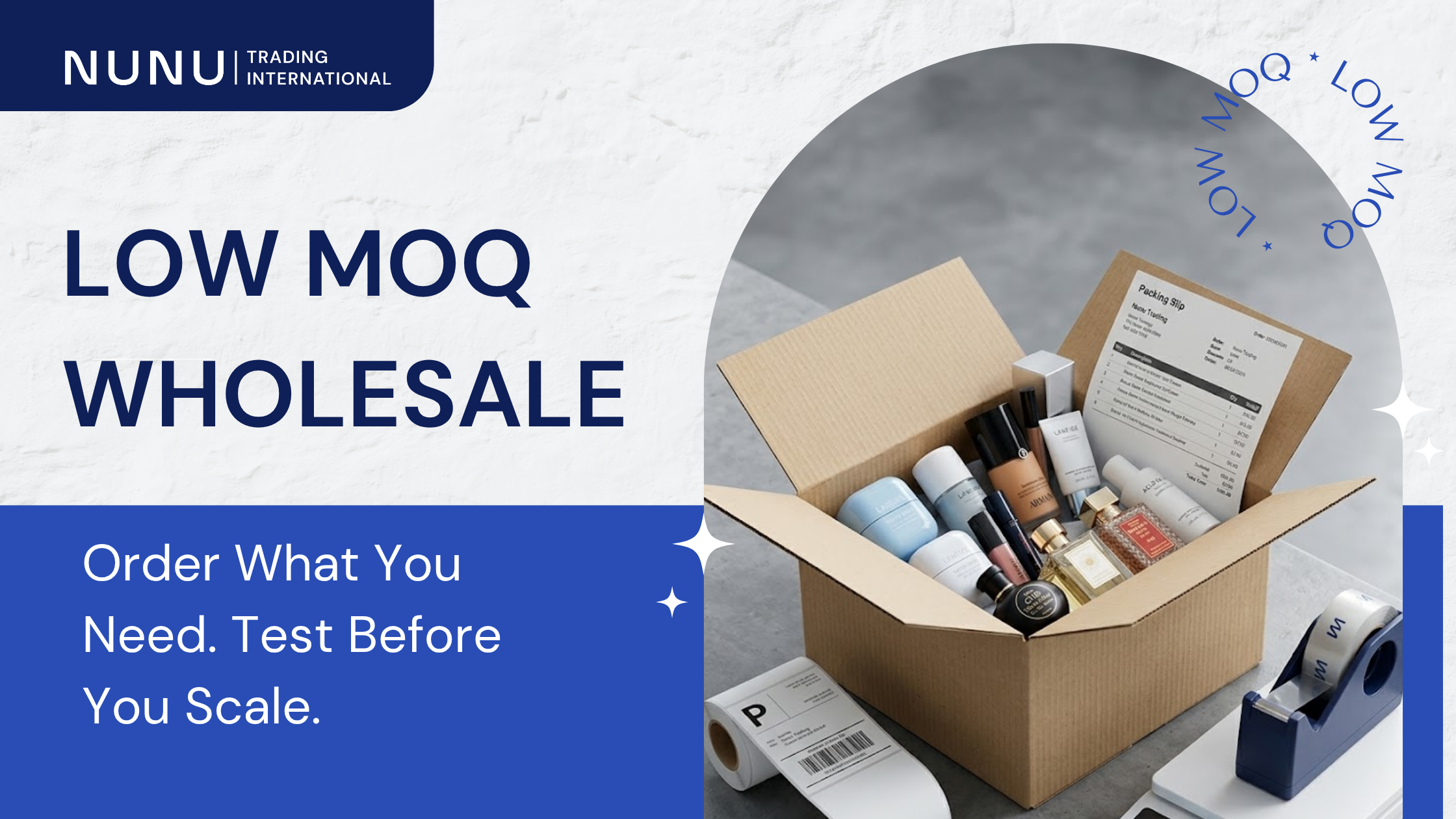
In wholesale beauty distribution, minimum order quantities are one of the most consequential — and least discussed — variables in a buyer's profitability equation. Every distributor understands what a MOQ is. Far fewer have calculated what a poorly calibrated one is actually costing them.
High minimum order requirements force buyers to overcommit on inventory before they know how a product will perform in their market. The result is predictable: excess stock, tied-up capital, forced markdowns, and margin erosion that begins the moment the pallet arrives. In 2026, the buyers gaining ground in European beauty distribution are those who have recognised that purchasing flexibility — not just purchasing volume — is a strategic asset.
This article breaks down what MOQ means in practice, the real cost of excess inventory in wholesale beauty, how a low MOQ threshold changes the economics of distribution, and why testing new references before scaling is one of the most reliable paths to sustainable margin.
What Is MOQ and Why Does It Matter for Beauty Distributors?
MOQ — minimum order quantity — is the smallest order a wholesale supplier will accept, expressed either in units or in monetary value. In practice, it determines how much capital a buyer must commit upfront before seeing a single unit sell through.
For large retailers and established distributors with high volume and diversified product ranges, a high MOQ is manageable. For independent retailers, Amazon FBA sellers, and small-to-mid-size distributors building or testing new product categories, it represents a structural barrier — one that pushes them toward inventory risk they cannot fully absorb.
Inventory carrying costs are a significant and often underestimated component of total wholesale cost — covering storage, capital cost, insurance, handling and obsolescence risk. When a buyer is forced to order more than demand justifies, they enter a carrying cost cycle that erodes the margin on every unit held beyond the optimal stock level.
The Real Cost of Excess Inventory in Wholesale Beauty
The connection between high MOQs and excess inventory is direct. A supplier requiring a minimum of 500 units per reference forces the buyer to either commit at that volume or source elsewhere. For a reference the buyer has not yet tested in their market, that commitment carries significant financial risk.
The cascade is well-documented: excess inventory requires forced markdowns, which compress margin; capital locked in slow-moving stock cannot be redeployed into faster-moving references; and warehouse carrying costs accumulate regardless of sell-through rate. These dynamics change substantially when a buyer can order closer to actual demand — which is only possible when the supplier's MOQ is low enough to allow precision purchasing.
How a Low MOQ Threshold of EUR 300 Changes the Equation
A wholesale platform with a EUR 300 minimum order — covering multiple references across categories — fundamentally changes how a buyer can approach their inventory strategy. The operational implications are significant:
1. Order Against Real Demand, Not Projected Demand
When the cost of entry is EUR 300, a buyer can place an order that reflects actual sales velocity rather than a volume target imposed by the supplier. This eliminates the primary driver of excess inventory in wholesale beauty: the obligation to over-buy in order to access the product at all.
2. Test New References Before Scaling
A low MOQ makes it commercially viable to introduce a new reference — a niche fragrance, a new skincare subcategory, a seasonal gift set — without a significant capital commitment. The buyer can assess sell-through, gather customer feedback, and make a data-informed decision about whether to scale before committing to high-volume replenishment.
This is particularly relevant for Amazon FBA sellers, where listing performance data is available quickly and inventory decisions can be adjusted in near-real time. A low MOQ entry point allows FBA sellers to test new references without the listing failure risk that comes with over-investing in unproven stock.
3. Maintain a Leaner, More Profitable Inventory Position
Leaner inventory means lower carrying costs, better cash flow, and a faster response to demand shifts. In a category like beauty and perfumery — where trends move quickly, seasonal demand is real, and consumer preferences are increasingly individualised — the ability to reorder frequently at low minimums outperforms the strategy of buying large and hoping sell-through follows.
4. Diversify Your Reference Mix Without Overexposure
With a low MOQ, a buyer can spread a EUR 300 order across multiple references rather than concentrating it on a single SKU. This creates a more representative and commercially resilient stock position — allowing buyers to identify which references perform best in their specific market before committing further capital.
High MOQ vs. Low MOQ: The Operational Comparison
| Factor | High MOQ Supplier | Low MOQ Supplier (EUR 300) |
|---|---|---|
| Capital commitment per order | High — forces over-buying relative to demand | Low — aligned to actual sales velocity |
| Inventory risk | High — excess stock likely on unproven references | Low — test before scaling |
| Cash flow impact | Negative — capital locked in buffer stock | Positive — capital redeployed faster |
| New reference testing | Costly — high exposure before any sell-through data | Low cost — commercial viability before scaling |
| Carrying cost exposure | High — excess inventory accumulates holding costs | Reduced — stock levels closer to real demand |
| Reorder flexibility | Limited — cycle driven by MOQ, not demand | High — reorder when stock depletes, not on schedule |
| Markdown risk | High — excess units eventually discounted | Low — less unsold stock to liquidate |
Reference Testing Strategy: How to Use Low MOQ Effectively
A low MOQ is only as valuable as the strategy behind it. For buyers new to precision ordering, the following framework provides a structured approach to using low minimums as a testing and scaling mechanism:
| Buyer Profile | Entry Approach | What Low MOQ Enables | Scaling Signal |
|---|---|---|---|
| Amazon FBA Seller | Test 2-3 new references per order at EUR 300 min | Listing data before volume commitment | Reorder when sell-through exceeds 60% within 30 days |
| Independent Retailer | Introduce 1-2 new categories per quarter | Customer feedback before full category commitment | Reorder at 2x volume when initial stock sells in under 6 weeks |
| Multi-channel Distributor | Pilot references across 2-3 channels simultaneously | Cross-channel performance data before scaling | Scale to higher volume when 2+ channels show positive sell-through |
How Nunu Trading's EUR 300 Minimum Supports Your Distribution Strategy
Nunu Trading's minimum order of EUR 300 — with no hidden thresholds or category restrictions — is designed specifically to give B2B buyers the flexibility to purchase in alignment with real demand rather than supplier-imposed volume targets.
- ✓ Multi-category access from EUR 300: a single order can cover perfumery, skincare, makeup and haircare references — no category-specific minimums.
- ✓ Daily-updated stock file: order against confirmed warehouse inventory, not catalogue projections. Check the live stock offer and what you see is what ships.
- ✓ EAN codes included: every reference in the stock file carries an EAN code for direct integration with FBA listing tools or ERP reorder workflows.
- ✓ Fast replenishment cycles: 24-48 hour dispatch in Spain, 48-72 hours across the EU — lean inventory strategy works when lead times are short and reliable.
- ✓ Full B2B invoicing compliance: every order invoiced to your registered business data, with intra-community VAT exemption for EU-registered buyers.
For buyers currently locked into high-MOQ supplier relationships, the practical alternative is clear: a platform with a EUR 300 entry point, daily stock visibility, and fast logistics gives you the conditions to manage inventory profitably — without sacrificing breadth of product range or speed of replenishment. This is precisely what supplier consolidation looks like in practice.
Start With EUR 300. Scale With Confidence.
Register for free as a B2B buyer on Nunu Trading. Download today's stock file, select your references, and place your first order — with no minimum beyond EUR 300 and no hidden conditions.
Published by Nunu Trading — Wholesale Perfumery & Cosmetics Distributor, Europe.