
Perfume Dropshipping in Europe: Risks and B2B Alternatives
Published by nunu on 01.10.26
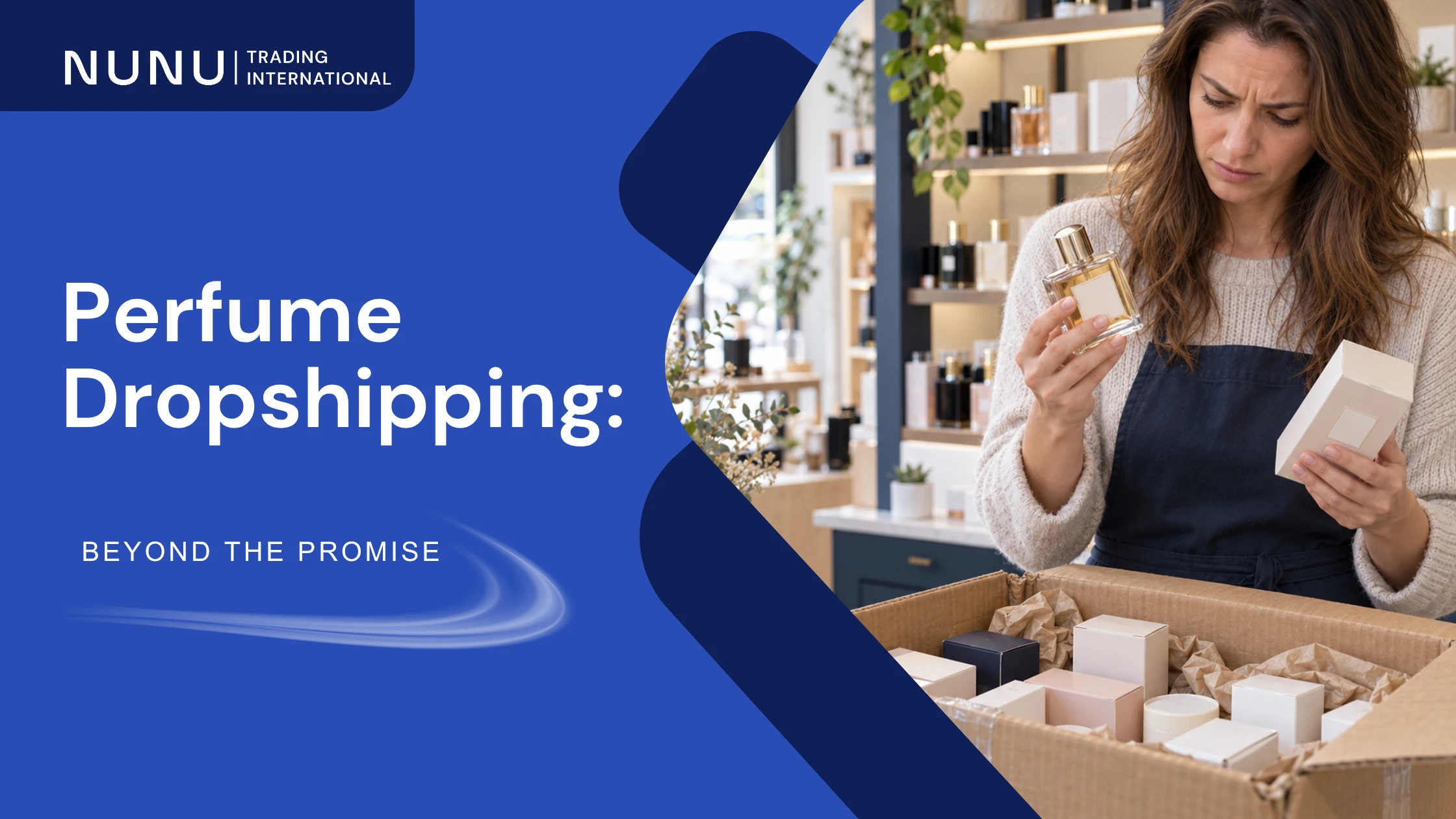
Dropshipping is one of the most widely discussed sourcing models in e-commerce — and one of the most misunderstood when applied to perfumery. The appeal is obvious: no inventory investment, no warehouse, no upfront capital commitment. But in the fragrance category specifically, the structural risks of perfume dropshipping are severe enough that for most serious B2B sellers operating in European markets, the model creates more problems than it solves.
This article explains how perfume dropshipping works, why the authenticity and compliance risks are acute in this category, why owning your own stock outperforms dropshipping for professional distributors, and what the low-MOQ wholesale model offers as a practical, lower-risk alternative that captures most of what makes dropshipping appealing — without most of what makes it dangerous.
What Is Perfume Dropshipping and How Does It Work?
In a dropshipping model, the seller lists products for sale without holding any inventory. When an order is placed, the seller forwards it to a third-party supplier, who ships the product directly to the end customer. The seller never handles the product and is not responsible for fulfilment.
For fragrance, this means listing perfumes from a supplier's catalogue, setting a markup over the wholesale price, and relying entirely on that supplier to pick, pack, and dispatch authentic, compliant products on your behalf — every time, at the quality level your customers and your marketplace account require.
The model has worked in product categories with standardised, easily verified quality: electronics accessories, apparel basics, household goods. In perfumery, where authenticity is the entire value proposition and where a single counterfeit unit can trigger an Amazon account suspension, the assumptions that make dropshipping viable elsewhere break down.
Authenticity and Compliance Risks in European Marketplaces
Key statistic: The global counterfeit perfume market reached USD 3.14 billion in value in 2025 — growing at a 15.8% CAGR, far outpacing the legitimate fragrance industry.
Source: Scento.com, Counterfeit Perfume Statistics 2026: The $3 Billion Fake Fragrance Problem, July 2026.
The scale of the counterfeit fragrance problem is the context within which European marketplace platforms — Amazon, Zalando, eBay — operate their seller policies. For dropshipping sellers, the risks are compounded precisely because they do not physically inspect the products they are selling.
The Counterfeit Risk
As documented by Dropship.io's Perfume Dropshipping guide, counterfeit products are endemic in fragrance wholesale at the lower end of the market. A dropshipping seller relying on an unverified supplier has no direct way to confirm that what is dispatched is the same as what was photographed in the catalogue listing. The risk is not hypothetical: TrueProfit's 2026 perfume dropshipping analysis notes that most major designer brands do not authorise third-party dropshipping, meaning that sourcing from unauthorised suppliers puts sellers at risk of counterfeits, IP disputes, and marketplace suspensions.
Amazon's Policy Position
Amazon's IP policy in EU and UK markets explicitly prohibits listings of fragrance products whose names, bottle designs, or logos are designed to resemble established brands. More critically, as FBAbox's analysis of Amazon's EU perfume policy notes, Amazon requires sellers to provide full authenticity documentation — supplier name, address, phone, and email — on request. A dropshipping seller who cannot produce this documentation, or whose supplier cannot withstand verification, faces immediate listing deactivation.
EU Regulatory Requirements
Selling cosmetics and fragrances in EU markets requires compliance with Regulation 1223/2009, EPR registration numbers for packaging waste, and GPSR-compliant product data. As covered in our guide on Selling Perfumes on European Marketplaces, these requirements apply regardless of fulfilment model. A dropshipping seller whose supplier ships non-compliant products — missing PAO symbols, incorrect labelling, absent Responsible Person data — bears full legal liability as the seller of record on the marketplace.
Between 2016 and 2019, EU customs seizures of counterfeit perfumes and cosmetics doubled. By 2024, European authorities detained approximately 112 million counterfeit goods valued at EUR 3.8 billion — a new record.
Source: Scento.com, Counterfeit Perfume Statistics 2026, July 2026.
Why Own Stock Outperforms Dropshipping in Perfumery
For professional B2B sellers operating at any meaningful volume in European markets, the comparison between dropshipping and owning your own stock is not close. The structural advantages of inventory ownership in fragrance are decisive across every commercially relevant dimension.
| Factor | Dropshipping | Own Stock (B2B Wholesale) |
|---|---|---|
| Product authenticity | Cannot verify before dispatch — supplier-dependent | Physical inspection possible; batch codes verifiable |
| Documentation for marketplaces | Dependent on supplier — often unavailable or non-compliant | B2B invoice issued to your business data; audit-ready |
| EU compliance (GPSR, EPR, CPNP) | Liability rests with seller of record — supplier may not comply | Full compliance manageable; documentation in your hands |
| Margin | Lower — supplier markup plus shipping reduces margin vs. direct wholesale | Higher — direct wholesale pricing, no intermediary |
| Inventory control | None — stock availability subject to supplier's position | Full — you own what you list; no surprise stockouts |
| Dispatch speed | Variable — depends on supplier location and process | 24–48h Spain, 48–72h EU with a well-structured supplier |
| Returns management | Complex — product must return to supplier, not you | Handled directly; faster resolution, lower cost |
| Account health risk (Amazon) | High — any supplier failure lands on your account metrics | Controlled — your stock, your QC, your documentation |
Comparison based on operational risk frameworks described in TrueProfit Perfume Dropshipping 2026, Dropship.io Dropshipping Perfume, and SoldScope Amazon Dropshipping 2026.
Related reading: How to Choose Your B2B Partner — Nunu Trading Blog
The five criteria every professional buyer must verify before committing to a wholesale supplier — authenticity, real stock, traceability, invoicing, and logistics.
The Hybrid Model: Low MOQ + Fast Dispatch as a Practical Alternative
The most common objection to owning your own stock is the one that makes dropshipping appealing in the first place: capital commitment. If a supplier requires 500 units per reference as a minimum order, the financial risk of stocking unproven references is real and significant.
The answer is not dropshipping. It is a wholesale model with a low minimum order quantity and fast dispatch — which replicates the capital efficiency of dropshipping while preserving the authenticity, compliance, and margin advantages of inventory ownership.
This model captures the three things that make dropshipping attractive — low upfront commitment, flexible ordering, fast fulfilment — while eliminating the three things that make it dangerous in perfumery: no product verification, no documentation control, and no compliance assurance. As discussed in our guide on Low MOQ Wholesale Beauty, a EUR 300 entry point allows professional buyers to test new references against real demand data before committing to higher volumes — which is exactly the risk management function that dropshipping is supposed to provide, without the legal and commercial exposure that comes with it.
Why Nunu Trading Is the Practical Alternative for European B2B Sellers
Nunu Trading operates as a B2B wholesale platform built specifically for professional buyers who need an alternative to opaque, high-risk supply chains — including sellers who have previously used dropshipping models and are looking to move to a more sustainable, compliant, and profitable structure. Nunu Trading does not offer dropshipping: every order is shipped to the buyer, who owns, inspects, and controls their own stock.
- ✓EUR 300 minimum order: no hidden thresholds, no per-category restrictions. Order what demand justifies, not what a supplier's MOQ forces.
- ✓100% authentic products: sourced through verified channels, with B2B commercial invoices that meet Amazon, Zalando, and EU documentation standards.
- ✓Daily-updated stock file with EAN codes: download confirmed warehouse inventory before ordering. No surprises after the order is placed.
- ✓24–48 hour dispatch in Spain, 48–72 hours across the EU: via Naeko (3PL) using GLS for parcels and TSB for pallets. Fast replenishment of your own stock, with full traceability.
- ✓Multi-category coverage: perfumery, skincare, makeup, and haircare from a single platform, invoice, and logistics flow. No multi-supplier complexity.
For a B2B seller who has been considering dropshipping as a way to reduce capital risk, the Nunu Trading model offers a direct alternative: the flexibility and low commitment that make dropshipping attractive, combined with the authenticity guarantees, documentation standards, and margin control that serious marketplace operations require — with the stock in your hands, not a third party's.
Register as a B2B Buyer on Nunu Trading
Create your free B2B account and access our daily-updated stock file with confirmed inventory, EAN codes, and wholesale pricing. Start with EUR 300 — no hidden conditions.
Published by Nunu Trading — Wholesale Perfumery & Cosmetics Distributor, Europe. www.nunutrading.com